A contribution from Expedition Urban Nature 2026, with thanks to biologist Ben Wielstra of Leiden University and Naturalis
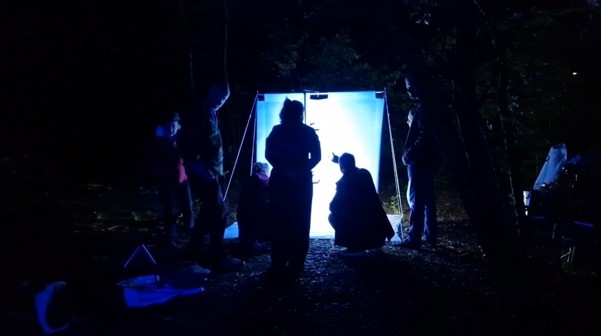
On Saturday, 16 May, at 9:00 in the morning, interested participants gathered in the gardens of the Hortus botanicus Leiden for the rapidly sold-out Salamander Safari, organised as part of Expedition Urban Nature. Led by salamander expert Ben Wielstra and his PhD candidate Anagnostis Theodoropoulos, both affiliated with the Institute of Biology Leiden and Naturalis, the group checked the traps that had been placed in the ponds the previous evening in search of newts.
Participants not only learned how to catch and identify the animals in an animal-friendly way, but also how researchers collect DNA samples using skin swabs. Wielstra does not use these DNA techniques exclusively for newts, however. He also took the opportunity to examine a very different resident of the Hortus: the midwife toad.
For many years, a population of midwife toads (Alytes obstetricans) has lived in the Hortus botanicus in Leiden. These unusual toads are not native to the region and were introduced at some point, but until recently it remained unclear where exactly they came from. Wielstra set out to find the answer using DNA barcoding.
The background
Midwife toads are remarkable animals: the males carry the eggs with them until the larvae hatch. Because the species does not occur naturally in Leiden, this population must have been introduced by people. But from where?
Wielstra saw this as an excellent opportunity to carry out, on a small scale, the same type of research that is also conducted nationally into the origins of introduced animal populations. By analysing the mitochondrial DNA, or mtDNA, of larvae, which remains largely unchanged from one generation to the next, researchers can determine the geographical region from which a population originated.
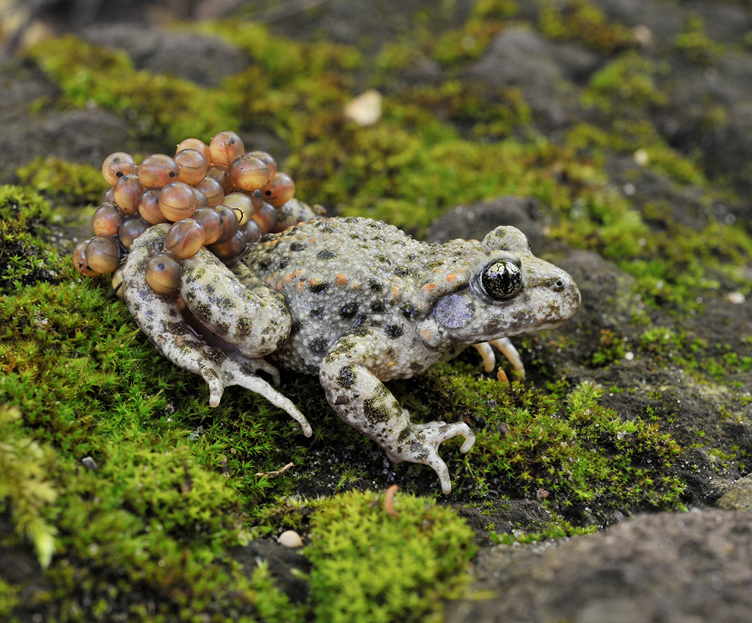
Photo credit: Rogier van Vugt
What did the research reveal?
All larvae carried exactly the same haplotype, with the memorable name Ao_H74. This haplotype proved to be exceptionally rare. Until now, it had been found at only one other location in the Netherlands: another introduced population in The Hague.
This is remarkable because the natural distribution of the midwife toad in the Netherlands has been studied extensively, and this haplotype has never been found there. This makes it unlikely that the Hortus population, like the population in The Hague, originated from a native Dutch population. All evidence points towards a foreign origin.
A trail leading to France?
One possibility is that the animals came from the Iberian Peninsula or the far south of France, where the species occurs naturally in large numbers. However, these areas have already been well mapped, and the Ao_H74 haplotype has not been found there.
Most of France, however, has been studied much less thoroughly in this respect. Wielstra’s working hypothesis is therefore that the source animal or animals of both the Hortus and The Hague populations originated somewhere in this under-researched part of France.
It also remains possible that the animals in the Hortus did not come directly from abroad, but were originally introduced from the population in The Hague.
Part of a wider story
This type of small-scale, local research fits perfectly with the philosophy of Expedition Urban Nature: bringing residents and biologists together to explore nature in and around the city. This may involve rare observations made through ObsIdentify or, as in this case, detective work into the genetic history of an urban population.
The midwife toads of the Hortus have long been favourites among visitors. Thanks to this research, we now know them a little better, even though the final word on their exact origins has yet to be written.
With thanks to Ben Wielstra for sharing these findings with Expedition Urban Nature.