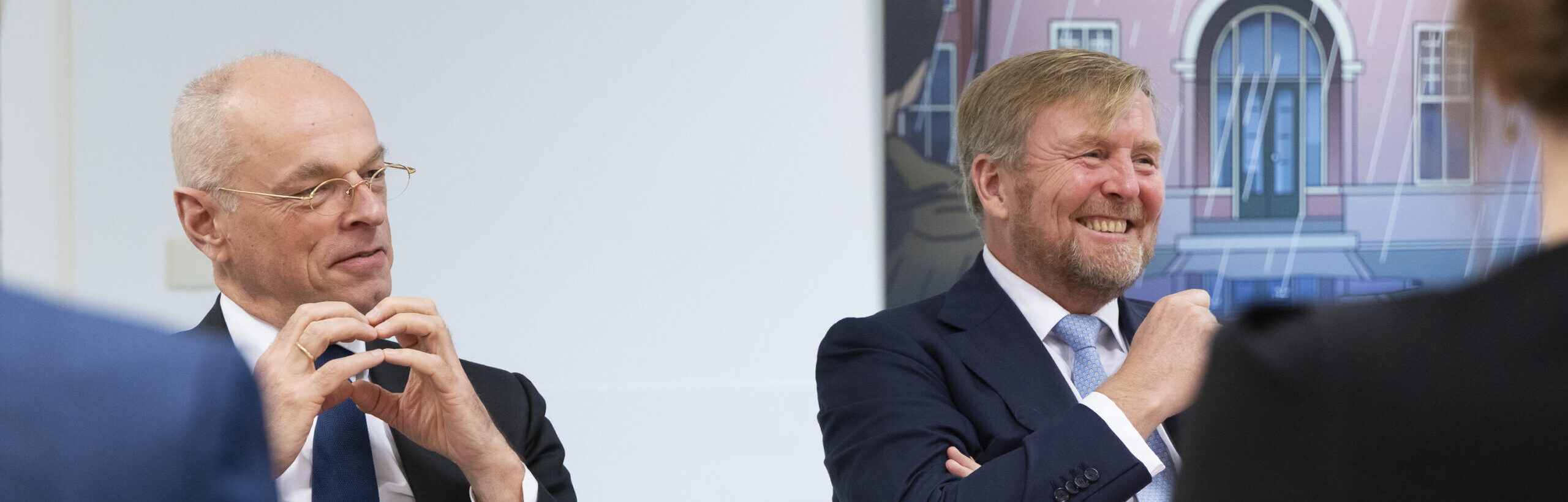
On Tuesday 16 December, Leiden University Medical Center welcomed His Majesty King Willem-Alexander and Minister Jan Anthonie Bruijn of the Ministry of Health, Welfare and Sport for a working visit focused on the future of healthcare. Central themes included the impact of an ageing population, growing pressure on healthcare staff, and the role of innovation and regional collaboration in keeping care accessible and effective.
Image-guided therapy without surgery
The visit started at the Leiden Image Guided Therapy Centre, where the King and the Minister were introduced to minimally invasive treatments that allow physicians to operate without traditional surgery. Using advanced medical imaging, doctors can treat conditions such as cancer, vascular diseases and stroke with high precision. This approach reduces recovery time, lowers the risk of complications and shortens hospital stays, contributing to better outcomes for patients and more efficient use of healthcare capacity.
Smarter triage in acute care
At the Emergency Department, the delegation received a demonstration of HARTc and SMART Triage, two initiatives that improve decision-making for acute patients already in the ambulance. By sharing real-time data and consulting specialists at an early stage, healthcare professionals can better assess whether hospital admission is necessary. Since its introduction, HARTc has helped prevent unnecessary hospital visits for around 20 percent of patients with suspected acute cardiac complaints. SMART Triage builds on this approach and supports the sustainable organisation of acute care in the region.
These initiatives are the result of close collaboration between regional partners, including Alrijne Hospital, Groene Hart Hospital, Leiden University Medical Center and the regional ambulance services.
AI supporting personalised cancer care
The final stop was the Department of Pathology, where researchers presented HECTOR, an AI model that accurately predicts the risk of recurrence in endometrial cancer. By offering more precise prognoses, this innovation helps clinicians tailor follow-up care to individual patients. Developments such as HECTOR reflect broader trends in Life Sciences and Health, where data, AI and medical research increasingly come together to improve patient care, a direction also highlighted in the recent Wennink report.
Regional collaboration as a foundation
The visit concluded with a roundtable discussion involving professionals from Leiden University Medical Center and regional partners, including the Health Campus, Leiden Bio Science Park, Haaglanden Medical Center, Alrijne, health insurer Zorg en Zekerheid and Leiden University. The conversation focused on strengthening regional cooperation through knowledge sharing, joint education and delivering the right care in the right place.
Together, these initiatives illustrate how collaboration between healthcare providers, research institutions and the wider ecosystem contributes to a resilient and future-oriented healthcare system.