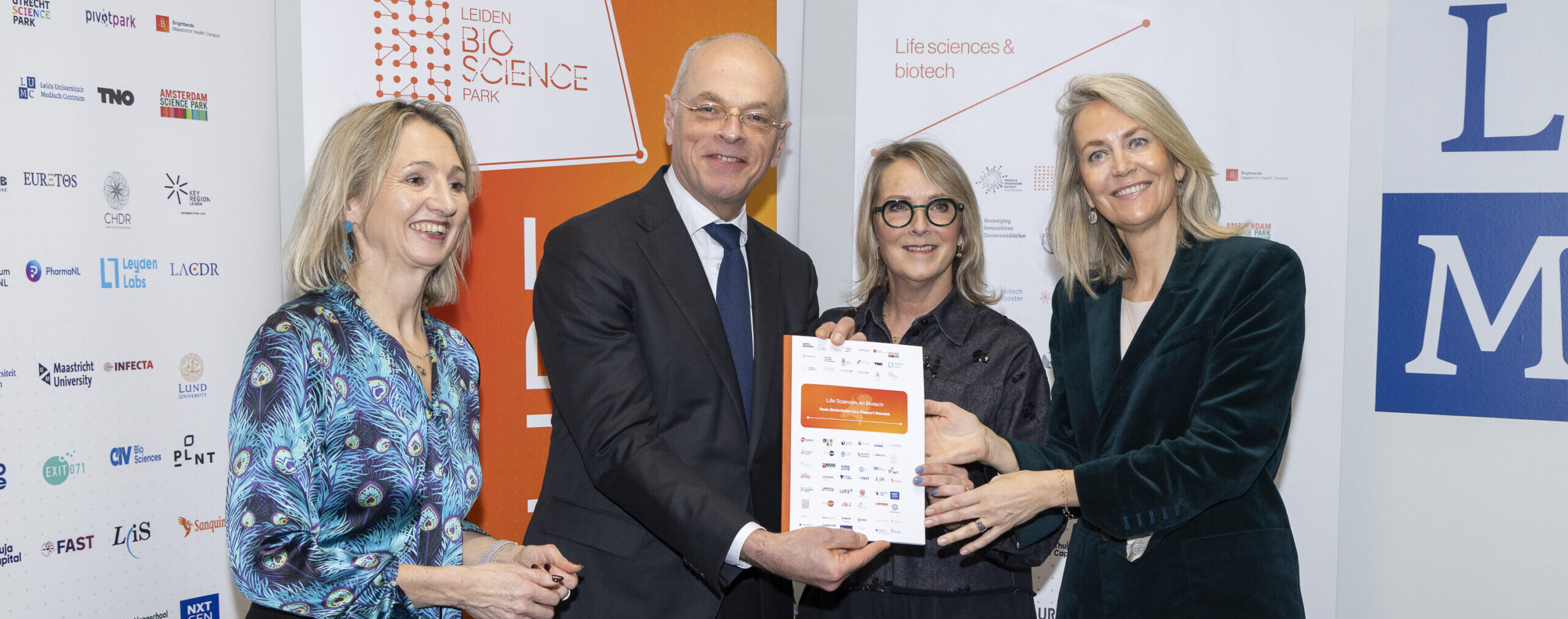
Vanmiddag nam minister Jan Anthonie Bruijn van het ministerie van Volksgezondheid, Welzijn en Sport in Leiden, bij het LUMC, het rapport ‘Nederland in de voorhoede: rode biotech als sleutel tot wereldwijde concurrentiekracht; een groeistrategie voor economie, maatschappij en patiënt’ in ontvangst.
Het rapport kwam tot stand op verzoek van Peter Wennink, in het kader van de nationale investeringsagenda, en vormt de gezamenlijke inbreng van de Nederlandse rode biotechsector. Leiden Bio Science Park werd door Wennink gevraagd het voortouw te nemen bij de totstandkoming van het plan en deed dat samen met hollandbio, in nauwe samenwerking met partners in Leiden én met de andere Nederlandse science parks, waaronder Groningen, Amsterdam, Utrecht, Oss en Maastricht en de Vereniging Innovatieve Geneesmiddelen. De economische analyse en modellering die het rapport onderbouwen, zijn uitgevoerd met betrokkenheid van KPMG.
Het rapport bevat een concrete strategie en aanpak om medische biotechnologie in Nederland versneld te laten groeien. Rode biotech maakt innovaties mogelijk die leiden tot snellere en betere diagnoses en tot gepersonaliseerde, effectievere behandelingen. Dat betekent betere zorg, betere levens voor patiënten en een duurzame bijdrage aan een toekomstbestendig zorgstelsel en een sterke economie. Juist op het snijvlak van gezondheid, maatschappij en verdienvermogen ligt een unieke kans voor Nederland in een sterk internationale markt.
Nederland beschikt over sterke clusters, hoogwaardige infrastructuur en internationaal erkende kennisinstellingen. Om dit potentieel te benutten, zijn gezamenlijke keuzes nodig: betere toegang tot kapitaal en talent, veilige en gedeelde toegang tot (bio)data, snellere en voorspelbare procedures voor vergunningen en klinisch onderzoek, en voldoende ruimte voor onderzoek, opschaling en productie.
Minister Jan Anthonie Bruijn van het ministerie van Volksgezondheid, Welzijn en Sport: “Biotechnologie brengt ons geneesmiddelen die echt baanbrekend zijn. Het door ontwikkelen van deze sector is dan ook belangrijk voor Nederland en niet te vergeten de patiënt. Ik zet mij daar actief voor in en zal onder meer onze belangen in Europa behartigen om te komen tot goede wetgeving via de Europese BioTech Act. Ik dank alle betrokkenen die hebben gewerkt aan de totstandkoming van dit rapport. Ik ga het met veel aandacht lezen.”
De sector stelt in het rapport onder meer de oprichting voor van een nationaal, politiek- en ministerie-overstijgend programma: Biotech Nexus. Dit programma moet kennisvalorisatie versnellen, bedrijven ondersteunen bij opschaling en gezamenlijk werken aan betere infrastructuur en snellere procedures.
“Rode biotech maakt het mogelijk om ziekten eerder te herkennen en patiënten gerichter en effectiever te behandelen,” zegt Esther Peters, directeur van Leiden Bio Science Park. “Dat betekent betere zorg en betere levens. We willen als Leiden en als sector, samen met het ministerie, nú in beweging komen en benutten wat vandaag al kan om innovaties sneller bij de patiënt te brengen. Door als science parks, bedrijven, kennisinstellingen en overheid samen op te trekken, maken we het verschil – voor de zorg, voor de patiënt én voor de toekomstige welvaart van ons land.”
“Nederland is groot geworden door te doen, niet door af te wachten” zegt Annemiek Verkamman, directeur van hollandbio. “Als we vandaag durven te investeren in innovatie en tegelijkertijd bouwen aan een zorgsysteem dat ook morgen werkt, is dat beter voor patiënten én de BV Nederland”.
Hiervoor is consistent en stimulerend overheidsbeleid over departementen heen nodig, met één duidelijke koers in plaats van tegelijk remmen en gasgeven,’ zegt Carla Vos, directeur van de Vereniging Innovatieve Geneesmiddelen. ‘Ik hoop dat de oproep van Peter Wennink leidt tot beleid dat Nederland aantrekkelijker maakt voor het ontwikkelen, produceren en lanceren van nieuwe producten, zodat zowel de economie als de zorg kan profiteren van nieuwe therapieën.’
English
This afternoon, Minister Jan Anthonie Bruijn of the Ministry of Health, Welfare, and Sport received the report “The Netherlands at the forefront: red biotech as the key to global competitiveness; a growth strategy for the economy, society, and patients” at the LUMC in Leiden.
The report was commissioned by Peter Wennink as part of the national investment agenda and represents the joint contribution of the Dutch red biotech sector. Leiden Bio Science Park was asked by Wennink to take the lead in drawing up the plan and did so together with hollandbio, in close collaboration with partners in Leiden and with other Dutch science parks, including Groningen, Amsterdam, Utrecht, Oss, and Maastricht, as well as the Association for Innovative Medicines. The economic analysis and modeling that underpin the report were carried out with the involvement of KPMG.
The report contains a concrete strategy and approach to accelerate the growth of medical biotechnology in the Netherlands. Red biotech enables innovations that lead to faster and better diagnoses and to personalized, more effective treatments. This means better care, better lives for patients, and a sustainable contribution to a future-proof healthcare system and a strong economy. It is precisely at the intersection of health, society, and earning capacity that a unique opportunity lies for the Netherlands in a strong international market.
The Netherlands has strong clusters, high-quality infrastructure, and internationally recognized knowledge institutions. To realize this potential, joint decisions are needed: better access to capital and talent, secure and shared access to (bio)data, faster and more predictable procedures for permits and clinical research, and sufficient space for research, upscaling, and production.
Minister Jan Anthonie Bruijn of the Ministry of Health, Welfare, and Sport: “Biotechnology brings us medicines that are truly groundbreaking. The continued development of this sector is therefore important for the Netherlands and, not least, for patients. I am actively committed to this and will, among other things, represent our interests in Europe in order to achieve good legislation through the European BioTech Act. I would like to thank everyone involved in the production of this report. I will read it with great interest.”
In the report, the sector proposes, among other things, the establishment of a national program that transcends politics and ministries: Biotech Nexus. This program aims to accelerate knowledge valorization, support companies in scaling up, and work together on better infrastructure and faster procedures.
“Red biotech makes it possible to detect diseases earlier and treat patients in a more targeted and effective manner,” says Esther Peters, director of Leiden Bio Science Park. “That means better care and better lives. As Leiden and as a sector, together with the ministry, we want to take action now and use what is already available today to bring innovations to patients more quickly. By working together as science parks, companies, knowledge institutions, and government, we can make a difference—for healthcare, for patients, and for the future prosperity of our country.”
“The Netherlands has grown by doing, not by waiting,” says Annemiek Verkamman, director of hollandbio. “If we dare to invest in innovation today and at the same time build a healthcare system that will also work tomorrow, that will be better for patients and for the Netherlands as a whole.”
This requires consistent and stimulating government policy across departments, with a single clear course of action rather than simultaneously applying the brakes and accelerating,” says Carla Vos, director of the Innovative Medicines Association. “I hope that Peter Wennink’s appeal will lead to policies that make the Netherlands more attractive for the development, production, and launch of new products, so that both the economy and healthcare can benefit from new therapies.”
Download hier het rapport
Nederland in de voorhoede: rode biotech als sleutel tot wereldwijde concurrentiekracht; een groeistrategie voor economie, maatschappij en patiënt
Download hier de one-pagers van het Wennink rapport
One pagers Wennink Rapport